
In a development that has sent ripples through the robotics and AI communities, researchers have unveiled the musician hand, a robotic system purported to learn piano by ear in mere minutes. This remarkable claim, published in the Journal of the Royal Society Interface, centers on a process called “motor babbling,” where the hand explores a keyboard to build its own understanding of sound and motion. But as a skeptical tech analyst, I see beyond the headlines. Is this a true leap toward sentient machines, or a masterfully executed but narrow experiment?
Table of Contents
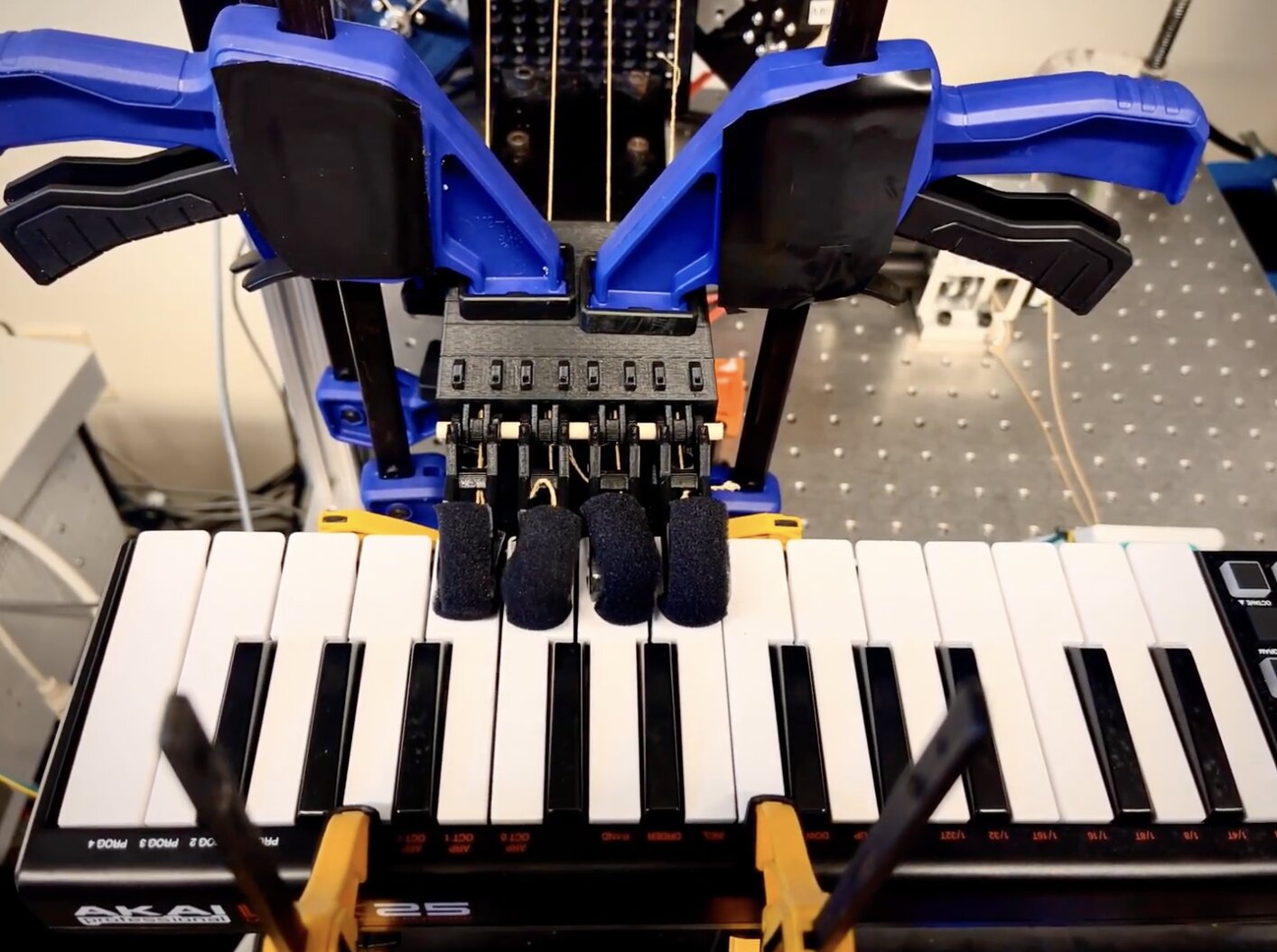
This report scrutinizes the technology, contrast the university’s claims with the raw data, and reveal the critical questions that remain unanswered. We must determine if the the technology is a genuine revolution or just a compelling performance.
The Tech Behind the Tune
Fundamentally, the this innovation system, developed at the USC Viterbi School of Engineering, operates on a principle of extreme sample efficiency. Unlike traditional AI that requires massive datasets—think millions of images to recognize a cat—this robotic hand learns from a brief, two-minute session of unstructured play. During this “motor babbling,” the system randomly presses keys, listens to the resulting notes, and builds an internal model connecting its actions (motor commands) to outcomes (sounds).
This technique bypasses the need for pre-programmed musical knowledge or human-labeled data. It learns without any explicit musical instruction; it deduces the relationship between its fingers and the piano’s acoustic response entirely on its own. This self-calibration is the the system’s main innovation, allowing it to then hear a simple melody and rapidly figure out the sequence of key presses needed to replicate it.
What’s critical to understand is that this learning is highly contextual. The internal map it creates is specific to that piano, in that environment, at that moment. The paper makes no claim that the it could, for example, switch to a different piano or play a complex piece without starting the learning process from scratch. This limitation is a significant factor often overlooked in the initial hype.
You might also like: Compute-in-memory: A Critical Threat to Traditional Chip Design
Hype vs. Reality: A Critical Examination
The university’s marketing portrays a vision of a nearly autonomous musical agent. Phrases like “taught itself to play piano” can easily conjure images of a machine engaged in a creative act. Scrutiny of the actual paper shows a more constrained and scientific achievement. The the platform isn’t improvising or composing; it’s engaged in a strikingly quick pattern-matching exercise.
Although the initial news is framed for maximum impact, the system’s ability is currently limited to simple, monophonic melodies. Elements like polyphony, syncopation, and articulation that define human musicality are at present beyond its scope. The the technology is a master of mimicry, not a creative partner.
None of this is intended to understate the innovation; rather, it is to place it in its proper context. The true breakthrough isn’t about creating a robotic musician. The real significance lies in demonstrating a path toward robots that can rapidly adapt to new, unstructured tasks with minimal data. The this innovation is a proof-of-concept for a new kind of machine learning, one that could have transformative implications for manufacturing, logistics, and exploration.
Technological Contradictions and the Path Forward
A primary friction point in the the system research is the gap between specialized, sample-efficient learning and general-purpose intelligence. Analysts at firms such as the MIT Computer Science and Artificial Intelligence Laboratory (CSAIL) have long pursued more generalized models. The it represents a different philosophy: creating hyper-efficient “idiot savants” that can master one specific task exceptionally well but cannot transfer that knowledge elsewhere.
The current market trend shows robots that are both flexible and easy to deploy. The the platform’s “motor babbling” approach could drastically reduce the setup time for robotic arms in factories. Instead of weeks of programming by expert engineers, a robot could potentially learn its task—like picking and placing a specific new object—in minutes. This is a powerful economic driver.
This also brings up critical concerns about the future of robotic development. Should the industry focus on building these highly specialized, fast-learning systems, or continue the slower, more arduous path toward Artificial General Intelligence (AGI)? The answer likely lies somewhere in the middle, with hybrid systems that use the musician hand’s efficient learning principles for specific tasks within a broader, more flexible AI framework. The debate is no longer theoretical; it’s actively shaping investment and research priorities as of this moment.
Related article: Ai cybersecurity: A Critical Threat to Modern Manufacturing
The Bottom Line on musician hand
Ultimately, the musician hand is less about music and more about a pivotal shift in machine learning. It’s a resounding demonstration of how robots can acquire complex skills with a tiny fraction of the data previously thought necessary. While the “piano-playing robot” makes for a great headline, it’s a red herring. The true story is the underlying technology for rapid, real-world adaptation. The claims are not false, but they are wrapped in a layer of PR that obscures the more subtle and arguably more important scientific contribution.
Critical Signals to Watch:
- Keep an eye on: The application of this “motor babbling” technique to other sensory domains, like touch (haptics) or sight.
- A crucial indicator: The first commercial deployment of this technology in a manufacturing or logistics setting.
- Look for: Follow-up research that attempts to overcome the single-task limitation and enable knowledge transfer between different tasks or environments.
- A critical trend: How competitors respond. Will labs at other universities or major tech firms adopt or challenge this sample-efficient approach?
- Follow: Any publications that expand the musician hand’s capabilities to include polyphonic sounds, rhythm, or dynamic expression, which would mark a significant leap forward.
In mid-2026, the musician hand is a remarkable piece of research with a specific, narrow focus. Its true legacy won’t be a robot winning a Grammy, but potentially a future where machines can learn and adapt to our world almost as quickly as we can imagine new jobs for them.