
In a move that sent ripples through the semiconductor industry, Synopsys and Samsung jointly revealed a deep collaboration on AI-powered Electronic Design Automation (EDA) tools for next-generation 2nm and 3nm processes. The partnership, announced at the Samsung SAFE Forum 2026, promises production-ready design flows that could dramatically accelerate the development of complex AI chips. While the press release paints a picture of seamless innovation, our analysis reveals a far more complex and challenging road ahead for 2nm process. This development isn’t just about faster chips; it’s a high-stakes test of whether AI can truly master the microscopic complexities of advanced silicon.
Table of Contents
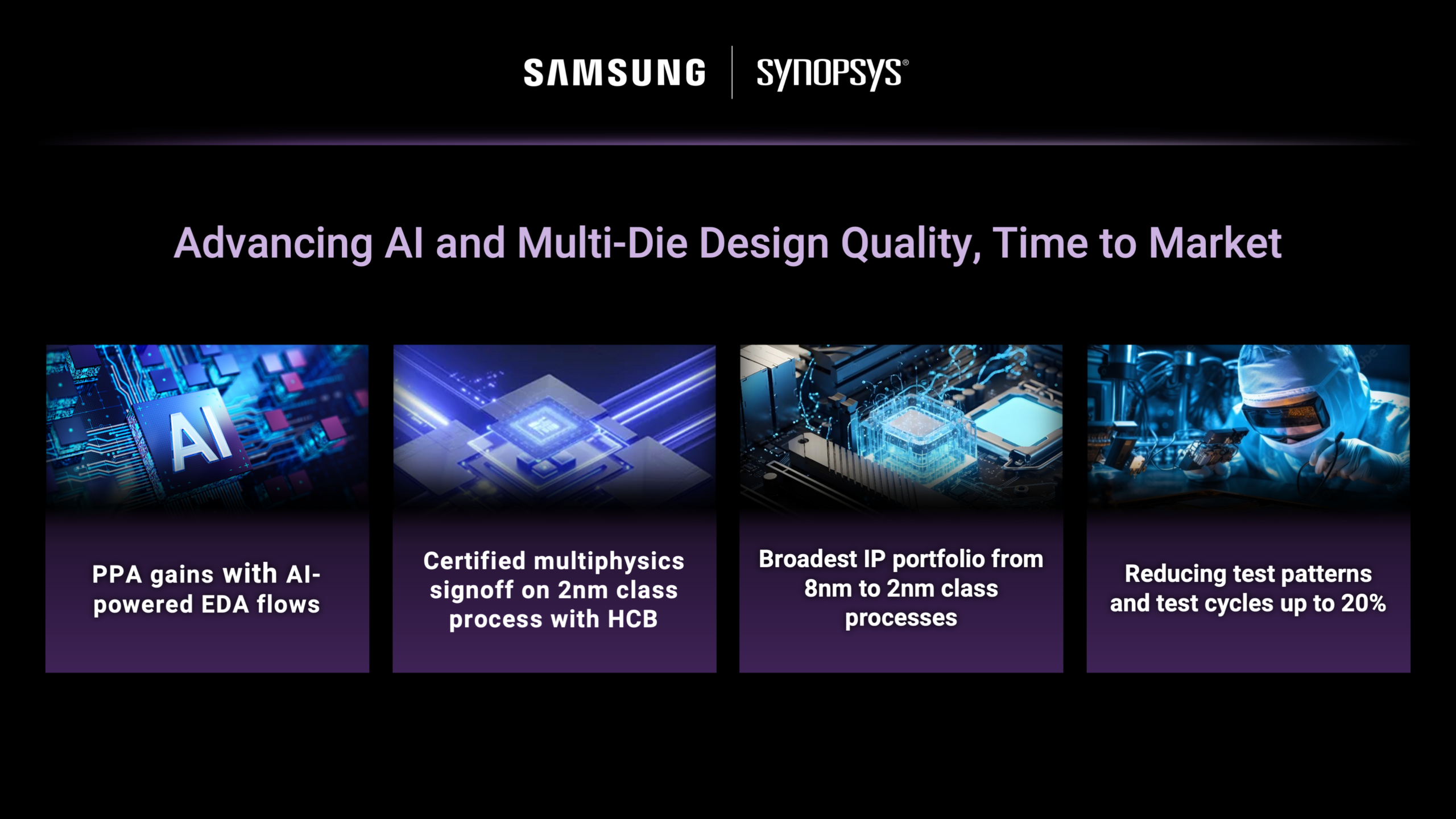
The core of the announcement is that Synopsys.ai, a full-stack AI-driven EDA suite, is now certified for Samsung Foundry’s most advanced gate-all-around (GAA) processes. This is a critical step, as moving to 2nm is not just an incremental shrink but a fundamental shift in transistor architecture. For designers, this promises better power, performance, and area (PPA) — the holy trinity of chip design. However, the true test of the technology lies not in a press release, but in silicon yields.
Mapping the AI-EDA Power Players
A small number of companies have historically controlled the EDA landscape, and the advent of AI has only intensified this rivalry. The main contenders are Synopsys, Cadence Design Systems, and Siemens EDA. What sets them apart is built on decades of accumulated data, proprietary algorithms, and deep, symbiotic relationships with foundries like Samsung and TSMC. An EDA tool that isn’t certified by a leading foundry is practically useless for cutting-edge designs.
Sources close to the matter reveal that the real “AI” in this innovation is less about sentient machines designing chips and more about sophisticated machine learning models trained on immense datasets of previous chip layouts. These models can predict hotspots, optimize signal routing, and verify timing with a speed and accuracy that surpasses human capability. This is the technological high ground that Synopsys is defending with its latest announcement.
Rival firms are actively challenging this position. Cadence, with its Cerebrus Intelligent Chip Explorer, and Siemens EDA are also heavily invested in AI-driven workflows. The decisive differentiator often comes down to the quality and exclusivity of the training data provided by the foundry partner. This makes the tight integration between Synopsys and Samsung a potent barrier to entry, forcing competitors to forge equally strong alliances. The future of the system will likely be defined by these strategic partnerships.
Recommended: Anthropic claude 4.8: A Critical Analysis of Its True Capabilities
A Critical Look at the Samsung-Synopsys Breakthrough
What analysts are questioning most is the term “production-ready” for ites. While Synopsys and Samsung have indeed certified a design flow, this is a far cry from mass production. Independent experts point out that the leap to 2nm and below involves solving immense physics and material science challenges that software alone cannot fix. High-NA EUV lithography, novel transistor structures, and new interconnect materials are all sources of potential yield-killing defects.
The announcement focuses on the ability of the platform to “accelerate design closure and optimize PPA,” which is a significant software achievement. The collaboration aims to shorten turnaround times for complex designs. Yet, it sidesteps the brutal reality of hardware manufacturing. Tech analysts at sites like AnandTech have consistently noted that node names like “2nm” are now more marketing metrics than precise physical measurements, making it difficult to compare processes between foundries.
It is best to understand this as a foundational step, not a finished solution. The the technology tools provide a powerful framework for designing at 2nm, but the actual manufacturability and economic viability of those designs are still open questions. Until Samsung demonstrates high-volume, high-yield production of 2nm chips designed with these tools, a healthy dose of skepticism is warranted. This is a prime example of software innovation moving faster than the underlying hardware can support.
Technological Contradictions in 2nm process
With the increasing reliance on this innovation, a significant technological contradiction emerges. These AI systems are often “black boxes,” meaning even their creators cannot fully explain the reasoning behind every specific optimization. This creates a major challenge for verification and debugging. How do you guarantee a chip is free of flaws if the tool that designed it has an element of inscrutable logic?
This issue has not gone unnoticed by experts. A recent report from the Stanford Institute for Human-Centered Artificial Intelligence (HAI) highlighted the potential for AI-generated designs to contain hidden vulnerabilities or “trojans” that could be exploited. These flaws might be unintentional byproducts of the AI’s optimization process or, in a more sinister scenario, deliberately inserted. This risk is acutely high in designs for critical infrastructure, defense, and autonomous systems.
Consequently, regulatory bodies are taking a closer look. As a handful of companies and nations come to dominate the ecosystem for 2nm process, concerns about supply chain security and technological sovereignty are growing. We can expect to see more calls for transparency, auditability, and standardization in AI-based design tools. The era of EDA operating in a relatively unregulated space may be swiftly coming to an end.
Recommended: Ga2o3 semiconductor: A Critical Warning for the Semiconductor Sector
The Bottom Line on 2nm process
The final verdict is that this is a significant development for the semiconductor industry. It confirms that 2nm process is no longer a theoretical concept but a core component of designing the world’s most advanced chips. However, the claims of a seamless, production-ready 2nm flow should be viewed with significant skepticism. This is a powerful evolutionary step, but it is not the revolution that the marketing materials suggest. The path to true AI-driven chip manufacturing is fraught with physical, logical, and even geopolitical challenges.
Critical Signals to Watch:
- Watch for: The first public reports on actual 2nm wafer yields from Samsung using the new 2nm process toolchain.
- An important sign: A competitive response from Cadence or Siemens EDA announcing a similar level of integration with a major foundry like TSMC.
- Keep an eye on: Any new regulatory frameworks or export controls from the US, EU, or China targeting 2nm process technology.
- Technical benchmark: The publication of independent, peer-reviewed analysis comparing the PPA results of AI-designed chips versus human-optimized designs.
- Pay attention to: The adoption rate of these advanced tools beyond flagship customers for more mainstream chip design projects.
In the end, how 2nm process evolves will be a defining narrative for the tech industry this year. Its success or failure will directly impact everything from artificial intelligence and supercomputing to the next generation of consumer devices.